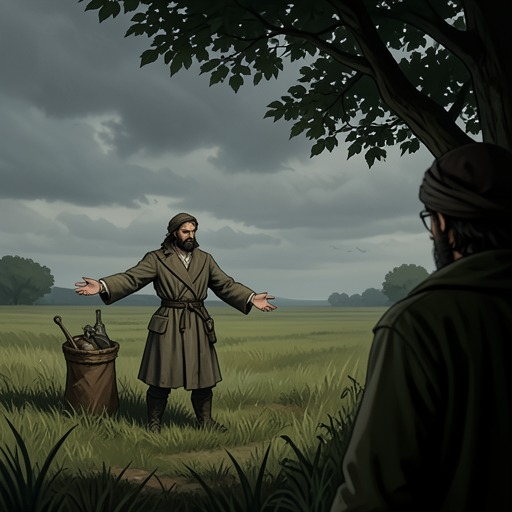
Vasili and Vanya share a farm and are separated by imprisonment
The Reincarnationist PapersVasili Arda and Vanya’s marriage is defined by a life built together on the land and broken apart by political upheaval: after they refuse to surrender their farm, both are imprisoned, and Vanya dies while Vasili is unable to reach her or learn what happened. His testimony gives the relationship its shape through shared work, enforced separation, and the uncertainty that remains after her death.
Life on the farm
Vasili recalls staying on the land with his wife through World War II in Bulgaria. His account places their marriage within the practical life of a farm: they remain there together until the Communist takeover and nationalization, when the authorities demand the property. The land is not simply a setting for their life as a couple; it becomes the point at which their shared household collides with a new political order.
The farm also belongs to the history of Vasili’s estrangement from his father. After returning from an earlier experience that had changed his outlook, Vasili found himself at odds with his father, an elder of an orthodox Christian sect. Their arguments gave way to silence except for matters directly related to running the farm. Vasili tried to buy land of his own, but his father died before he found anything suitable. His later account of remaining on the land with Vanya shows the couple’s life continuing within the agricultural world that had also been the source of that family conflict. The testimony does not specify when they married or describe their private life apart from the farm and the subsequent arrests.
Imprisonment and separation
The decisive rupture comes when the Communists take over and nationalize the property. Vasili says that he and Vanya were arrested after refusing to surrender their farm. Their resistance is presented as a shared act, but imprisonment turns a common decision into separate ordeals: Vasili serves a year and a half, while Vanya begins a similar sentence. The account does not establish that they were held in the same place or explain the conditions of either sentence.
Vasili identifies his own prison as State Prison No. 4, explaining that it had a number rather than a name. That concrete designation marks the institutional setting of his separation from Vanya, but it does not give him access to what happened to her. When asked what she died of, he answers that he does not know because he was in prison. The reason for his ignorance is not incidental: incarceration has cut him off from the information a husband might ordinarily expect about his wife’s illness or death.
Vanya’s death and Vasili’s uncertainty
Vanya dies shortly after beginning her sentence. Vasili’s account supplies no diagnosis, description of her final days, or report of how he learned she had died. He cannot say what caused her death, and the testimony does not fill that silence with an explanation. The separation imposed by imprisonment therefore persists even in retrospect: Vasili can recount that she died, but not the circumstances that would make her death fully knowable to him.
He is also cautious about the timing of her burial. Asked whether she was interred at about the same time as he was, he estimates that it was around the same time, probably within days, while acknowledging that he cannot be certain. The phrasing matters: even the chronology of their burials comes to him as an approximation, not a settled memory. The evidence supports a closeness in timing, but not a precise date or a shared burial place.
The relationship in retrospect
Vasili’s testimony preserves the marriage through a stark sequence: remaining together on the farm, refusing to give it up, being arrested, and then being separated by their sentences. The political loss of the land and the loss of Vanya are connected in his account, but they are not interchangeable. The authorities remove the ground on which the couple’s life had been organized; imprisonment then deprives Vasili of knowledge of his wife’s final days.
After his release, Vasili escapes to Turkey and lives in Istanbul until his death. His account does not describe a reunion with Vanya or offer further detail about their relationship after her death. What remains is the contrast between their shared refusal at the farm and the helplessness of separation: he knows that she died soon after entering a similar sentence, yet cannot say why, and can only place her interment within days of his own. The marriage is thus recalled less through declarations of affection than through the material life they shared and the uncertainty imprisonment left behind.